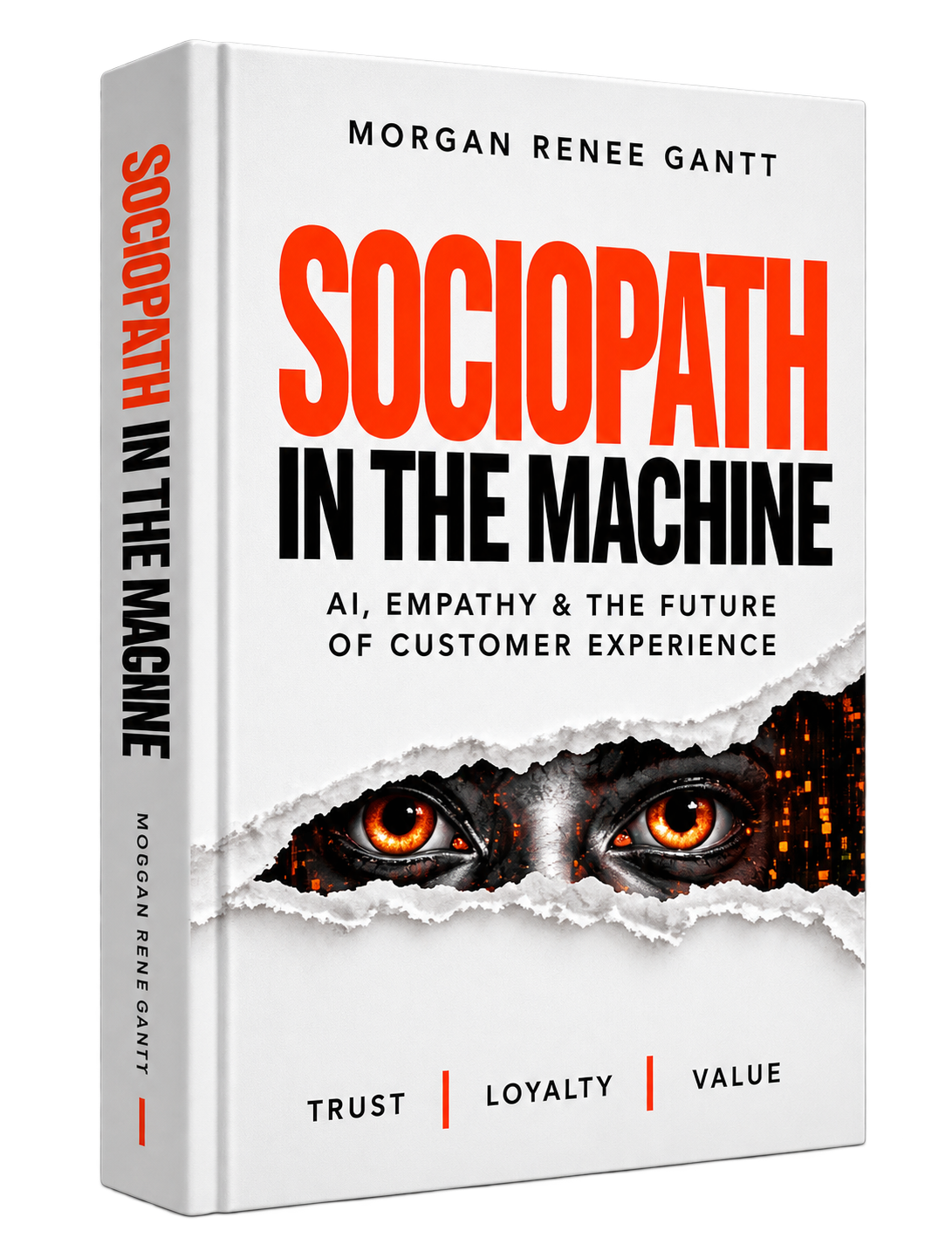
Sociopath in the Machine — Pre-Order
This is a digital pre-order. You will be charged at checkout. Release timing will be confirmed before launch.
CAN AI BE MORE EMPATHETIC THAN THE PEOPLE WHO DESIGN IT?
AI, Empathy & The Future of Customer Experience
Sociopath in the Machine is the next book in Morgan Renee Gantt’s Empathy For Sale series—and it begins with an uncomfortable question.
Companies are moving quickly to place artificial intelligence between themselves and the people they serve. Customer service. Product experiences. Recommendations. Decisions. Personalization. Support. Increasingly, interactions that once required another human being are being handed to a machine.
But handing the interaction to AI does not hand over the responsibility for empathy.
AI is designed by people, trained on human behavior, directed by organizational priorities and measured against outcomes that people choose. It inherits our assumptions, our incentives, our definitions of success—and the consequences of the decisions we make about where and how it should be used.
So before we ask whether AI can understand people, there is another question worth asking:
How seriously did we understand people when we designed the system?
THE SOCIOPATH IN THE MACHINE MAY NOT BE THE MACHINE
The title is deliberately provocative. It is not an argument that artificial intelligence is inherently malicious, nor that the people building it lack humanity.
It is a challenge to examine what happens when extraordinarily powerful technology is designed and deployed inside organizations where efficiency, optimization, scale and commercial performance can become easier to measure than empathy.
A machine does not experience frustration, vulnerability, dignity, loyalty or trust. But neither does an organization automatically protect those things simply because human beings work there.
Technology reflects choices.
What do we optimize? What do we automate? What do we remove? What behaviors do we reward? What outcomes do we monitor? And what human consequences are we willing to overlook because the numbers tell us the implementation is working?
The machine forces us to confront the values of the people and organizations behind it.
AI DOES NOT ABSOLVE THE ORGANIZATION OF ITS RESPONSIBILITY TO UNDERSTAND PEOPLE
One of the great promises of AI is that it can help organizations solve problems that have frustrated customers for years: long waits, inconsistent service, fragmented information, repetitive processes and experiences that depend too heavily on individual employees.
That promise is real.
But there is a dangerous assumption hiding inside it: that once the technology takes over the interaction, the organization has also solved the human problem.
It has not.
The more human interaction a company replaces with AI, the more intentional it must become about protecting empathy in the design, implementation, governance and measurement of those systems.
Because the customer still experiences the consequence—even when no human employee is present.
WHAT ARE WE ACTUALLY REPLACING?
Before automating an interaction, organizations need to understand what existed inside it.
Was the employee simply completing a transaction? Or were they also providing context, reassurance, discretion, judgment, sensitivity, escalation or the ability to recognize that this particular customer did not fit neatly into the process?
When companies measure automation primarily through cost reduction, speed, containment or productivity, those less-visible human functions can disappear without ever appearing on an implementation dashboard.
Just because an interaction can be automated does not mean the human role within it has been properly understood before it is removed.
DESIGN IT. MONITOR IT. QUESTION THE REPLACEMENT.
DESIGN IT — What are we teaching the machine?
Examine the assumptions, incentives, biases, business rules and definitions of success being embedded into AI-enabled experiences. Empathy cannot be treated as a feature added after the technical architecture is complete.
MONITOR IT — What happens to people after deployment?
Measure more than efficiency, conversion, containment and cost. Watch what happens to trust, comprehension, dignity, customer effort, accessibility, agency and the relationship between the customer and the company.
QUESTION THE REPLACEMENT — What human capability are we removing?
Understand the role human judgment played before deciding that technology should replace it. Some interactions require speed. Others require context. The difficult ones often require both.
WHAT YOU’LL EXPLORE
- Empathy by design — how customer understanding becomes an intentional requirement in AI product and experience development rather than an assumption.
- The humans behind the machine — how organizational incentives, business priorities, assumptions and definitions of success influence what AI ultimately does.
- The replacement problem — what companies can unintentionally remove when they automate interactions they have not fully understood.
- Human judgment — where discretion, context, sensitivity and accountability still matter even when a system can technically make the decision.
- Measurement after implementation — why organizations need to monitor the human outcome of AI, not simply its operational performance.
- Trust, loyalty and value — how AI-mediated experiences can strengthen or damage the customer relationships businesses depend on.
- Dark patterns and unintended consequences — how existing organizational behaviors and incentives can become more powerful when automated and scaled.
- Responsibility and governance — why an organization remains accountable for the experiences and decisions produced by the systems it chooses to deploy.
EFFICIENCY IS NOT THE SAME AS EMPATHY
An AI interaction can be faster than a human interaction. More consistent. Available twenty-four hours a day. It may even appear more patient and attentive than the human experience it replaced.
That creates one of the most interesting questions in the book:
Could a machine actually appear more empathetic than the humans who designed it?
Perhaps.
But appearing empathetic and being accountable for human consequence are not the same thing.
The challenge for organizations is not to choose between humans and technology. It is to determine how technology can improve the experience without allowing automation to become an excuse for abandoning the responsibility to understand the people experiencing it.
THE NEXT CONVERSATION AFTER EMPATHY FOR SALE
Empathy For Sale asks: Do we actually understand the customer?
Sociopath in the Machine asks: What happens to that responsibility when AI begins interacting with the customer for us?
The first book establishes empathy as a business capability. The second asks organizations to protect that capability as technology becomes increasingly responsible for delivering the experiences customers associate with the company itself.
Together they make a larger argument: technology can change how a company interacts with people. It does not change the company’s responsibility for what those people experience.
WHO THIS BOOK IS FOR
Written for executives, founders, product leaders, customer experience teams, technology leaders, AI and automation teams, digital leaders, operations leaders, designers, marketers and consultants making decisions about where and how AI enters the human experience.
You do not need to be an AI specialist. This is a business and leadership conversation about people, technology, responsibility and consequence.
THE RESPONSIBILITY DOES NOT TRANSFER TO THE MACHINE
AI will become more capable. Companies will continue to automate. More interactions will move from people to systems.
The question is whether organizations will become equally sophisticated about understanding and monitoring the human consequences of that transition.
AI does not inherit the responsibility of empathy from us. It inherits the consequences of how seriously we took that responsibility when we designed it.
DIGITAL PRE-ORDER
Pre-order the digital edition now and receive the book automatically when it is released. Release timing will be confirmed before launch.
Sociopath in the Machine · Digital Edition Pre-Order · $29.